My name is Julia Johnson, I’m a third year student at UOW studying communications, majoring in digital media. I’m originally from England, moving to Australia when I was 7. I’ve lived in Australia for nearly 14 years now but still occasionally miss England, more now than ever due to covid. Entering my third year, I wanted to really push myself this year as I am (barely) getting the hang of being a part of online studies. I
Last year I found myself being barely motivated due to Covid and slightly delaying my studies in result. I moved to part time studies and exceled in the fewer subjects I had. Although I found this process a lot easier, I now have to play catchup moving back to full time studies. I’m definitely excited to be on campus again, even if it’s just for one subject and I’m even more excited to begin my third year at university. Every year at university brings new opportunities and challenges and I am keen to delve into whatever comes my way.
Throughout this semester in BCM206, I have curated content on ‘TikTok’, a popular social media platform that allows you to produce short videos following trends and popular sounds. I had previously made videos on this platform for BCM112 and BCM114. I wanted to make more videos after previous success on the application when I reached around 400k views on one of my videos. Based off my research and previous experience, taking part in trends and using viral sounds as early as possible can aid in getting maximum views and likes, with this information I tried my upmost effort to catch trends early yet also incorporate my own interpretation of the trend.
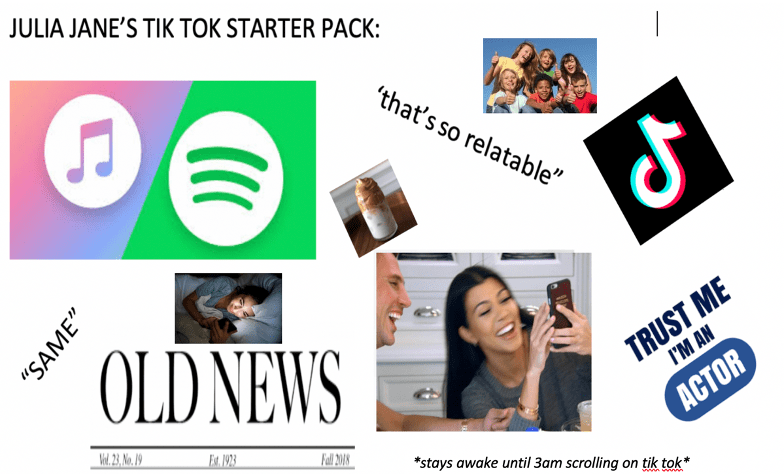
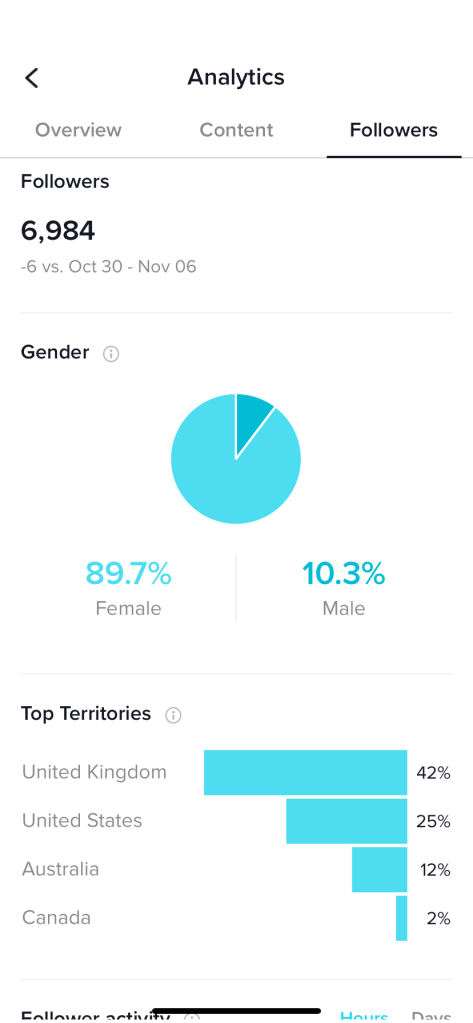
I made an audience starter pack in order to lay out what I expect from viewers. I decided I would post around 3-4 videos each couple of days, tracking my views, likes and followers. With an established 7000 followers, I hoped I would have them boost my engagement and share the videos around. Due to the large growth on TikTok, as I prerequisite I researched how many people had downloaded the application since I last did a digital artefact. Oberlo stated that over 100 million users had downloaded the application since May 2020.
Learning Moments:
The subject’s topics of anonymous resistance and digital feudalism strung true with my digital artefact. With a viral application such as TikTok, comes trolls, hacks and insensitivity as we learnt in anonymous resistance. As I learnt this, I contributed it to my work, making sure it was censored and remaining respectful to avoid backlash. Digital feudalism remained coherent in my digital artefact as well, the algorithm of TikTok being a large part of short-lived success. TikTok according to Later, the algorithm of TikTok relies on the amount of followers one has and how the engagement is preceded.
One learning moment that strung true for me was the beginning of my digital artefact when I first posted. I used an audio with moderate amount of views and users, the videos received over 42k views and 9000 likes. Little did I know, the timing of when I posted my video and the sound I used. Each were both effective in my engagement. I learnt timing is everything when comes to posting on any social media platform, due to the average amount of people online at any time. The Influencer Marketing Hub stated that the best times to post on TikTok (EST) where on average 6am, 10am, 4pm and 10pm.
Over this semester, Sophie and I have spent hours on a topic that really interested us “Online Advertising Amongst Social Media Platforms“. We really enjoyed collabing on this project together and hope you enjoy our final product!
Throughout BCM241, Sophie and I have studied the ins and outs of the online advertising industry. Many Influencers sole income is based online, from advertisements on instagram stories to collaborations with major companies. The question that lingers however is where does this money come from? The answer lies with the backbone of online organising – the platforms and companies.
Essentially, the most interacted advertisements are online. Whether you are scrolling through TikTok or swiping on Tinder, the social media platform smoothly transition into short advertisements that unavoidably catch your attention. The advertisements only last from 5 seconds up to 30 seconds, they are extremely annoying, agitating but unavoidable and plainly there. Having advertising on social media makes it the most intractable form of advertising. In comparison to television advertisements and billboards, you can access a website to buy the advertised products or actions almost immediately by swiping up on Instagram or simply clicking the advertisement on Facebook, for example.
Taking it a step further, companies target rising influencers to post about their products, whether this is subtly or direct. Companies could ask for an influencer to post on their Instagram story or make a direct post to advertise the desired product. According to ‘Sprout Social: What is influencer marketing: How to develop your strategy‘ a step by step guide on how to do marketing as social media influencer, they suggest that for micro influencers (who have under 1000 followers) receives around $87 and this grows with the amount of followers an influencers has, a influencer with over 100000 followers averaging around $763 a post.
Subtle forms of advertisement from influencers can often be seen in videos or in the background of posts. An example of this, is the popular energy drink ‘Bang’. Many large TikTok influencers post videos talking about random stuff or moving around a room whilst holding and drinking the energy drink. This strategy draws in the viewer’s attention but still remains subtle and unwitting.
Despite what form of online advertising is used, the online advertising industry is a large money machine that produces significant revenue. The advertising itself producing more attention and money than the purchasing of products. This industry will only continue to grow as our annoyance also continues to grow 😂.
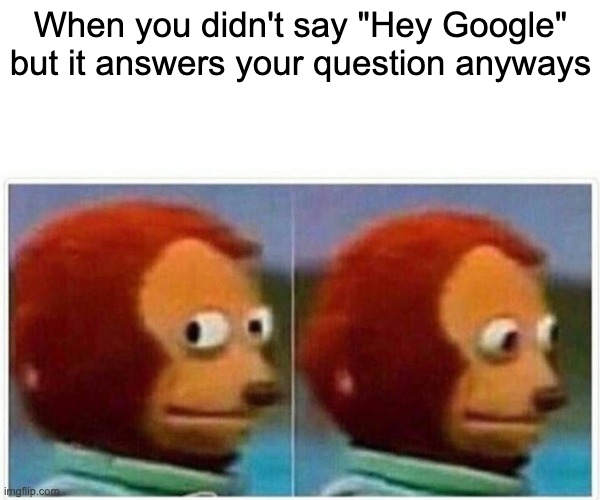
The final week of BCM206, wow. This week we learnt about IoT devices, and the future of daily life in accordance to advices. The progression of electrical devices is advanced upon its years, we now have ability to ask them to do what we command or track where we are. A journal by Nicola Rua called “Secure communication for smart IoT objects” studies the extent of advancement in technology. According to this reading, IoT objects have the ability to change our daily routine, activities and behaviours. As this type of technology begins to further adapt, our individual environments are bound to change rapidly, whether this is easing daily life or becoming more invasive to our private life. The adaptation of such devices brings the desired future of technology, yet it holds the question of when it can be taken too far.
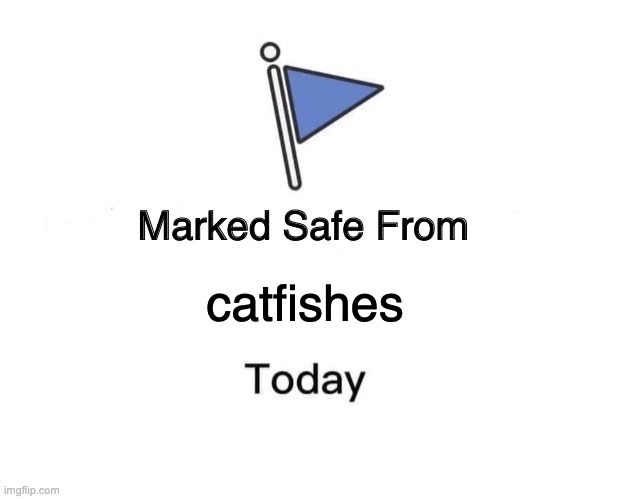
Over the past couple of weeks, the topics we have studied in BCM206 closely correlate. This week we studied the use of fake identities, specifically in the US military. The use of fake identities is commonly found online, its notoriously known as “Catfishing”. The concept is so popular (yet uncomforting) that there was an American reality tv show made on the concept called “catfish” (obviously). In an article by Vulture called “Here’s how MTV’s catfish works”, the journalist studied the way catfishing effects an individual. Catfishing is not only a danger, but a mental mind game. ‘Catfishes’, as they’ve been nicknamed, prey on vulnerable people online leading them to believe they are someone else, scamming money at of them and/or leading them into a fake relationship online. These cases tend to become a large scaled and long length scams.
The internet can notoriously be known as a dangerous place. Any personal information can be exposed to nearly anyone with the power to use invasive technology to find your personal details and use them against you. I found an interesting reading called “hacker, hoaxer, whistle-blower, spy”. The journal examines the many evils of the online community, within its first chapter, it studies the online group of hackers called “anonymous”. The group became an online sensation in 2008, that also scared millions of people globally. They first targeted an American news company for their lack of judgement, exposing hacked details from the company to expose them. Over the year since, the group has cemented its place online and is both feared and respected. The internet continues to not be a thoroughly safe or kind space and has many loopholes, it is always important to protect your information with protective software to protect your information.
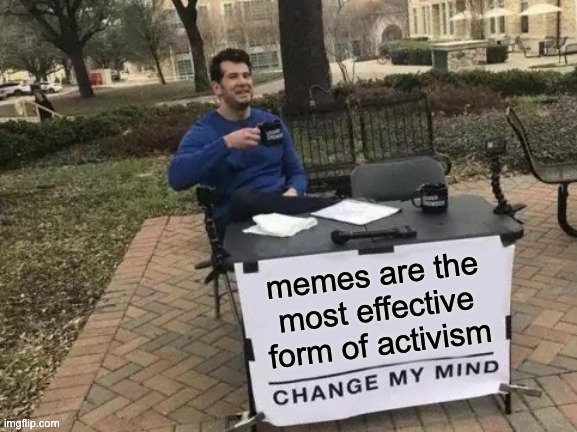
Social Media, from the dawn of its creation, has always been used as a source of activism and campaigning. Online platforms ignite far larger amounts of attentions and can attract global participation. Examples of social media being used in this light is the recent and current “black live matter” movement and the Me-Too movement. Along with campaigning, ‘Memes’ are guaranteed and have been weaponised to incite further attention. Technology review studied the weaponisation of memes. Through an example, the author identified how any photo posted online can be doctored to be whatever the creator desires, essentially becoming a meme. In these social media movement, memes are spread across social media platforms to further spread messages and often can be encrypted or even false. The only doubt in social media is the blurred line of what is real and can be trusted and what is fake.
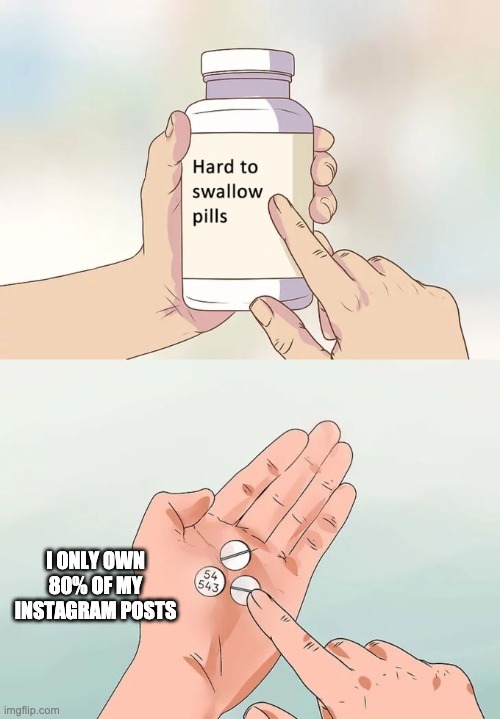
This week we discussed the practices in place online and how this affects us as digital user of content individually. During this topic, I found an article by ‘web strategist’ about digital feudalism and how there is essentially an online hierarchy. Creatively, it links back to medieval times to explain the similarities in online feudalism. Any digital creator who has made online content has unwillingly agreed to terms and conditions on the ownership of this content and will essentially never wreak the full benefits (whether this is minor or extreme) of their own content. The online hierarchy allows large investors and owners to overrule digital content and have some form of ownership of anything, to a certain extent, on a chosen platform. For example, creators on YouTube who make videos, do not fully own the content they have made, YouTube itself has a certain amount of claim on these videos.
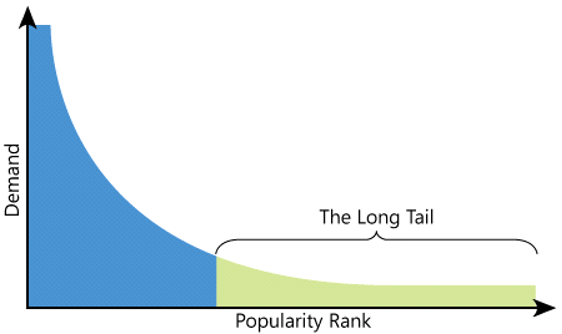
The long tail effect was discussed by Chris Anderson in 2015 described as a statistical term for online marketing. The 2020 article “Understanding the long tail theory media fragmentation and niche marketing” provides further information on this week’s topic, expanding on the theory of unlimited space online for large and small companies to influence. According to this reference, Amazon overtook Walmart in 2019 as the most powerful retailer globally due to online marketing, proving Chris Anderson’s theory of unlimited digital influence and online shelf space. The long tail effect is at a constant battle, the positives being the mote attention an online platform provides and the larger productions whereas the negatives include the lack of staff required and the uphill battle of having desired attention online due to this unlimited amount of shelf space and the millions of companies online.




 justjules.travel.blog